
British Guiana 1c Magenta
The world's rarest and most valuable stamp. Known as the 'Mona Lisa of stamps', this octagonal 1856 magenta stamp is the only known surviving example of its kind, valued at $9.48 million.
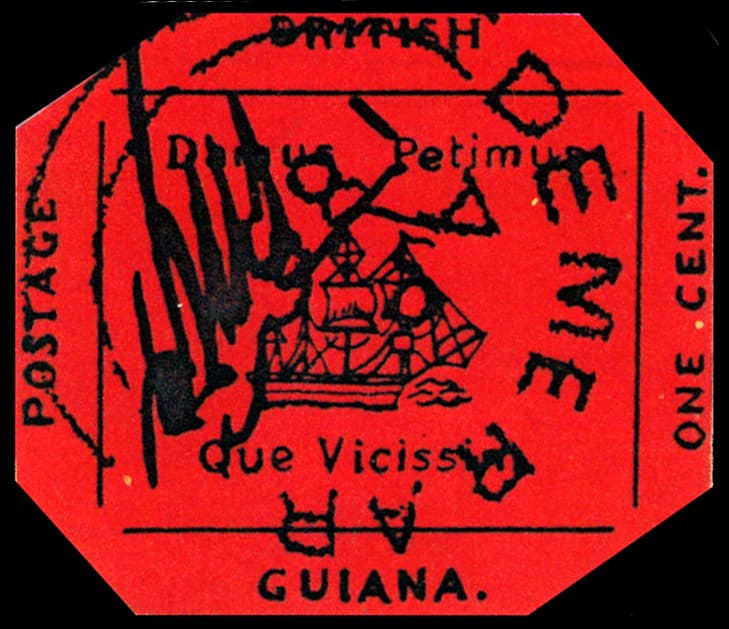
British Guiana (now Guyana) · 1856
British Guiana 1c Magenta
Overview
The British Guiana 1c Magenta is the holy grail of philately — the world's only known surviving stamp of its type, making it definitionally the rarest postage stamp in existence. Issued in 1856 when the South American colony of British Guiana (now Guyana) ran out of imported stamps from England, local postmaster Edwin Dalton arranged for stamps to be printed by the Official Gazette newspaper. These emergency provisionals were printed in black ink on magenta (deep pink) paper, featuring a ship and the colony's motto 'Damus Petimus Que Vicissim' ('We Give and We Seek in Return'). The stamp was discovered in 1873 by a 12-year-old schoolboy named Vernon Vaughan in an attic in British Guiana. He sold it for a few shillings, not knowing its value. It passed through several major collections over the following century, each time breaking the world record price for a stamp. In June 2021, Sotheby's sold it for $9.48 million — the highest price ever paid for a single postage stamp — to Stanley Gibbons, the world's oldest stamp dealer.
Design & Technical Details
Octagonal shape (the corners cut off a rectangle). Black ink printed on magenta paper by the Official Gazette of British Guiana. Depicts a three-masted sailing ship surrounded by the text 'BRITISH GUIANA' and the value '1 CENT'. Inscribed with the colony's motto. Each stamp was initialed by a postal clerk as an anti-counterfeiting measure.
Historical Facts
- Issued in February 1856 as an emergency measure when imported stamps ran out
- Printed locally by the Official Gazette newspaper — not by a professional stamp printer
- Discovered in 1873 by 12-year-old Vernon Vaughan in an old box of family papers
- First major sale: purchased by famous collector Count Philippe de la Renotière von Ferrary around 1878
- Von Ferrary's collection was seized as war reparations after WWI and sold at auction 1921-1925
- The stamp has broken the world record for most expensive stamp at every subsequent sale
- In 2021, Stanley Gibbons purchased it for $9.48 million at Sotheby's
- It is now on public display rotating between exhibitions worldwide
How to Identify This Stamp
If you believe you may have found a British Guiana 1c Magenta, here are key identification characteristics to check:
- There is only one — any claimed 'second example' is either a forgery or a misidentification
- The octagonal shape results from the corners being cut; not all corners cut at the same angle
- Original initials from a postal clerk should be visible (typically 'EDW' for E.D. Wight)
- The magenta color is distinctive — not red, not pink, but a specific deep magenta
- The ship design is printed in black ink directly on the magenta paper
- The stamp has been thinned and repaired over 150+ years of handling
Frequently Asked Questions
Why is the British Guiana 1c Magenta so valuable?
Because it is the only known surviving stamp of its type in the world. Scarcity is the ultimate driver of value in any collectible — and you cannot get scarcer than a population of one. Additionally, its dramatic discovery story, century-long auction history, and status as 'the world's rarest stamp' create a cultural cachet that drives collector demand beyond pure philatelic value.
Where is the British Guiana 1c Magenta today?
Since 2021, it has been owned by Stanley Gibbons, the world's oldest philatelic company, who purchased it at Sotheby's for $9.48 million. It is available for public viewing at rotating exhibitions worldwide. Previously, it was displayed at the Smithsonian's National Postal Museum in Washington DC.
How was the British Guiana 1c Magenta discovered?
In 1873, a 12-year-old schoolboy named Vernon Vaughan found it in an old box of family papers in British Guiana. Not knowing its significance, he sold it to a local stamp collector named Neil McKinnon for a few shillings. McKinnon recognized it as unusual and sold it to a Liverpool dealer, L. Vernon Smythe, who then helped bring it to international attention. It was eventually acquired by famous collector Count Philippe de la Renotière von Ferrary.
Could another British Guiana 1c Magenta be discovered?
It's theoretically possible but considered extremely unlikely. The stamps were issued as an emergency measure in a small colony in 1856 — 170 years ago. They were used for postage on ordinary mail. The survival of even one example is considered miraculous. If additional examples existed, they would likely have surfaced in the century-long history of intensive philatelic research.